
How to Save Money on Grocery Shopping in India
Simple ways to cut your monthly grocery bill in India, from comparing price per kg to using coupons and buying seasonal produce.

Grocery shopping is one of those expenses that keeps coming back whether we plan for it or not. Rice, dal, cooking oil, vegetables, milk and all the little things we pick up for the kitchen eventually find their way into our monthly grocery expenses.
And here’s the thing: we don’t always realise how much we’re spending until we look at the final bill. Sometimes, it’s because we bought things we already had at home. At other times, a discount makes us pick up an extra packet or two, even when we didn’t really need them.
Saving money on grocery shopping doesn’t necessarily mean buying cheaper products or giving up the things you enjoy. It can be as simple as changing a few shopping habits and paying a little more attention to where your money goes.
If you’re looking for ways to reduce your monthly grocery budget without compromising on quality, here are seven practical grocery shopping tips worth trying.
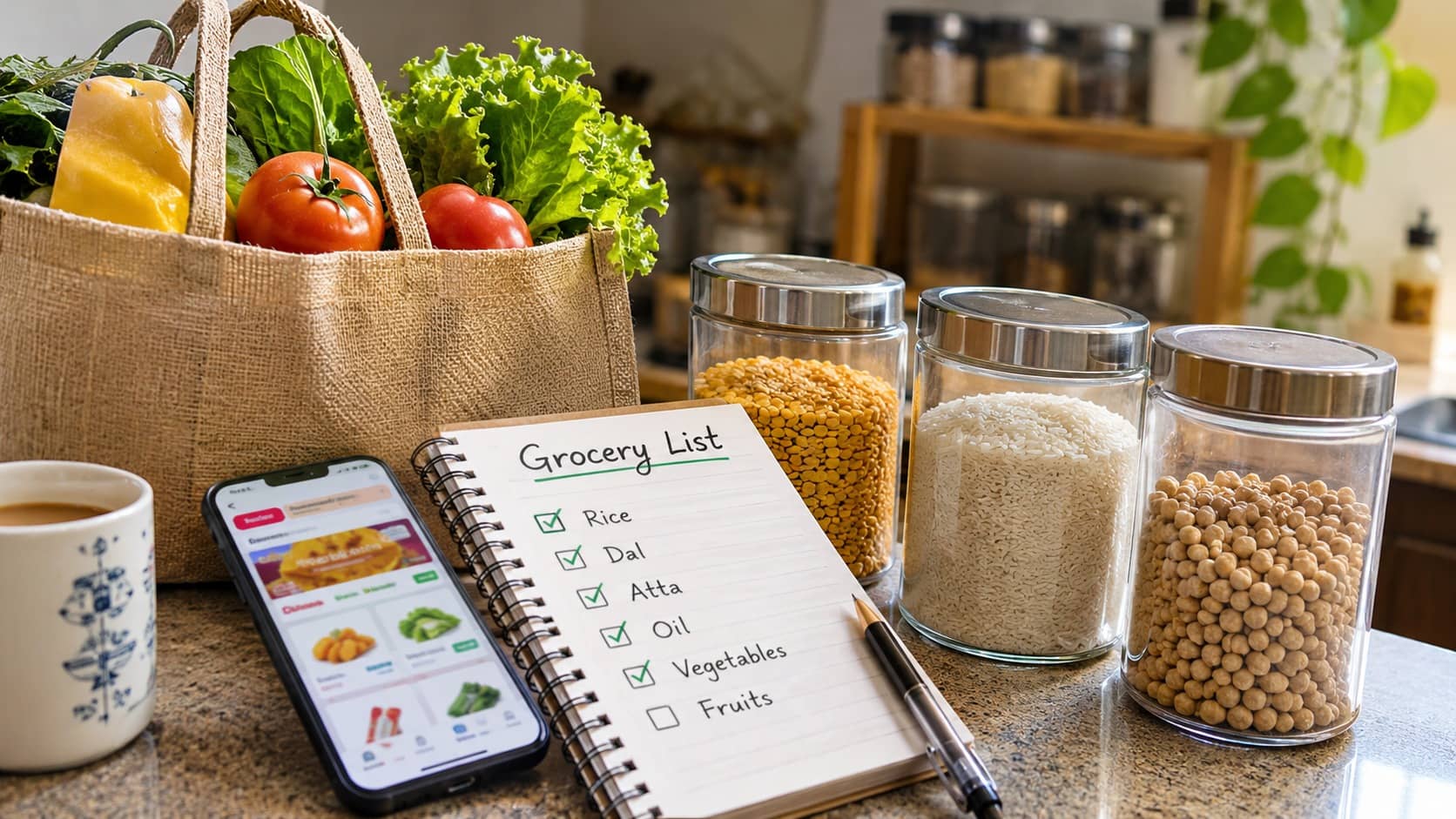
1. Make a grocery list before you start shopping
How often do we walk into a supermarket or open a grocery app only to realise that we haven’t really decided what we need? It’s easy to keep adding things to the cart when everything looks tempting, especially when there’s an offer attached to it.
Before heading out, take a look at your kitchen shelves, refrigerator and pantry. You might already have another loaf of bread, a carton of eggs or a jar of coffee tucked away somewhere. Buying the same thing again simply because it’s on offer isn’t much of a saving. It can also lead to unnecessary waste.
Once you know what you already have, prepare a grocery list based on what needs to be replenished. You can also plan a few meals for the coming week. This makes it easier to figure out how much of each ingredient you’ll actually use.
A shopping list may seem like a small thing, but it gives you a clear idea of what you’re looking for. And perhaps more importantly, what you can skip.
2. Compare grocery prices per kilogram or litre
A bigger packet doesn’t always mean a better deal. Sometimes, we pick up larger packs assuming they’re cheaper without checking whether we’re actually getting more for our money.
Let’s take Aashirvaad Whole Wheat Atta on BigBasket as an example. On 18 November 2026, it was listed at these prices:
| Pack size | Price | Price per kg |
|---|---|---|
| 1 kg | ₹65 | ₹65.00 |
| 2 kg | ₹99 | ₹49.50 |
| 5 kg | ₹149 | ₹29.80 |
| 10 kg | ₹547 | ₹54.70 |
Prices change often and may vary by location.
Here, the 10 kg pack works out to ₹54.70 per kg. That’s more than the 2 kg pack at ₹49.50 per kg. The 5 kg pack, which had a 53% discount, was the cheapest at just ₹29.80 per kg.
So a bigger pack doesn’t always mean better value. Even for the same brand and product, comparing the price per kg across pack sizes can help you find the cheaper option.
In this case, the 5 kg pack gives the best value. If your household uses atta regularly, it makes sense to pick that one.
But pack prices keep changing, so don’t assume the same pack will be cheapest next time. Compare the quantity and price before deciding which pack to buy. In India, applicable pre-packaged commodities are required to display unit sale prices under Legal Metrology rules, making it easier for consumers to compare different pack sizes.
This is particularly useful when buying everyday essentials such as rice, pulses, flour, sugar and cooking oil. A little attention to the price per kilogram or litre can help you save money on regular grocery purchases.
3. Buy groceries in bulk, but only when you know you’ll use them
Buying groceries in bulk can be useful, especially when it comes to products your household uses regularly. Detergent, dishwashing liquid and certain cleaning products are often worth buying in larger quantities.
But there’s a difference between buying in bulk to save money and buying more than you can use.
For instance, a larger pack of detergent might offer a better price per kilogram. But purchasing several packets of something you rarely use could leave them sitting in your pantry for months. The same goes for fruits and vegetables. A discount on a larger quantity isn’t particularly useful if half of it ends up going bad.
One way to manage this is to separate your grocery purchases into monthly and weekly requirements.
- Monthly purchases: Rice, atta, lentils, cooking oil, sugar, spices and other non-perishable essentials.
- Weekly purchases: Milk, bread, fruits, vegetables and other fresh products.
This way, you can stock up on things you regularly use without filling your kitchen with products you might not get around to using.
4. Compare local stores and online platforms
With neighbourhood provision stores, supermarkets and online grocery platforms offering different prices, there’s no reason to assume that one option will always be cheaper than the other.
Your local grocery store might offer a better price on certain staples, while an online platform could have a discount on packaged products or household essentials. It really depends on what you’re buying.
Before placing a large order, compare the same products across two or three options. Make sure you’re checking the same brand, quantity and variant. Otherwise, the price comparison may not be particularly useful.
For quick-commerce apps, you can use Savey’s grocery price comparison tool to check the same product on Zepto, Blinkit, JioMart and more in one place.
And when shopping online, don’t stop at the product price. Delivery charges, handling fees, platform charges and minimum order requirements can change the final amount.
Quick-commerce platforms such as Blinkit, Zepto and Instamart are convenient when you suddenly run out of something. But placing several small orders throughout the week can make it harder to keep track of how much you’re spending.
There’s nothing wrong with choosing convenience when you need it. Just try to plan your regular grocery purchases in advance and keep quick-commerce orders for those unexpected situations.
5. Choose seasonal produce and explore local alternatives
Have you noticed how the price of certain vegetables changes depending on the time of year? Fruits and vegetables that are readily available during a particular season are often more affordable than produce that is less abundant.
Instead of buying the same vegetables throughout the year, take a look at what’s available in your local market. You might find that choosing seasonal produce gives you more variety without stretching your grocery budget.
Local vegetable markets and neighbourhood vendors are also worth exploring. You can compare prices, check the freshness of the produce and buy quantities that suit your household.
Onions are a good example. Their prices go up and down through the year. About 70–75% of India’s onions come from the rabi crop, which is harvested between March and May. With fresh stock in the market, prices are usually lower around April and May. They tend to rise later in the year, in the months before the kharif crop arrives in October and November.
That’s why many Indian households buy onions in bulk when prices are low. Rabi onions keep well for a few months if you store them properly. Choose firm, dry onions with no sprouts or soft spots. Keep them in a cool, dry and airy place, not in plastic bags. Check them every few days and remove any that turn soft.
There’s another option worth considering: supermarket private-label products. Many retail chains and grocery platforms sell their own versions of everyday essentials such as packaged snacks, breakfast cereals and cleaning products.
They may be cheaper than familiar national brands, but that doesn’t automatically make them better value. Compare the ingredients, quantity, quality and price before switching. If the product meets your requirements, you could save a little without compromising on what you buy.
6. Use grocery coupons, cashback and bank offers wisely
This is where a little planning can actually pay off. Grocery platforms such as BigBasket, JioMart and Amazon Fresh periodically offer discounts on selected products and categories. You may also come across bank offers, promotional coupons and cashback deals while checking out.
Before placing an order, take a moment to see which offers apply to your purchase. You can find the latest grocery coupons and deals on Savey. But don’t forget to read the conditions.
Some coupons require you to meet a minimum order value, while bank discounts may be available only on selected cards. Cashback, too, may be credited to your account later rather than deducted from the bill immediately.
The idea is to make the offers work around your shopping requirements, not the other way around.
7. Reduce food waste and make better use of what you buy
We often focus on finding cheaper groceries, but what happens after we bring them home matters just as much.
Leafy greens forgotten at the back of the refrigerator, bananas bought in excess and bread that goes stale before anyone finishes it can all add to household expenses. Check what you already have at home and plan your purchases around what your household can realistically use.
The bottom line
Whether you prefer visiting your neighbourhood market or ordering groceries online, there’s always room to be a little more mindful about what goes into your cart.
Plan your purchases, compare prices, make use of offers that genuinely benefit you and avoid buying more than your household needs.
After all, grocery shopping is something we’ll keep doing every week or every month. Making a few smarter choices along the way helps us get better value from the money we spend.